Learning Through Play at Home: What It Really Looks Like
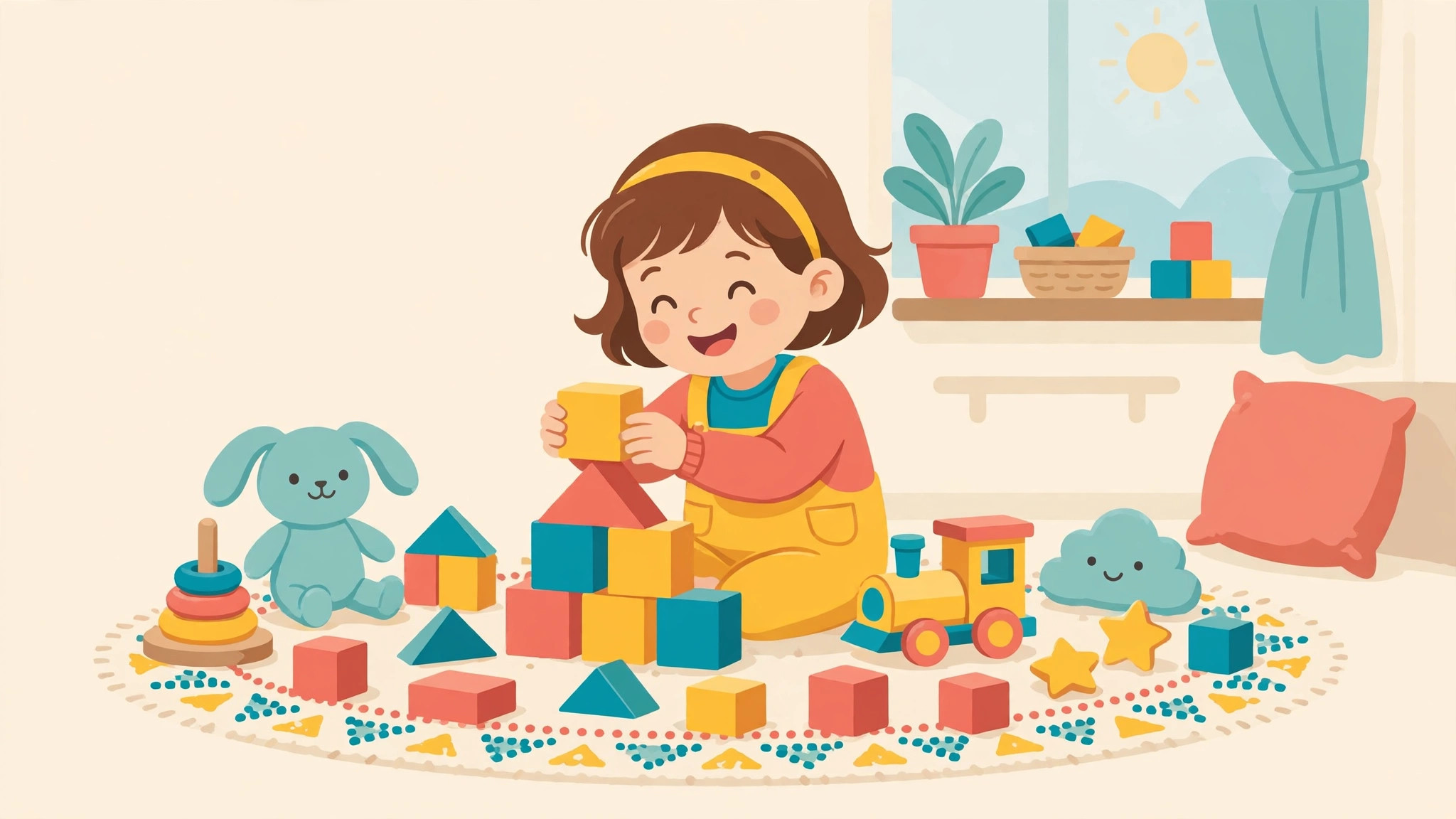
"Children learn through play" is printed on every preschool brochure — and explained by almost none of them. So parents nod, then quietly worry: if play is the curriculum, should the block tower be taller? Am I supposed to be doing something? This guide answers that honestly. Learning through play is not a technique you perform; it is what already happens when a young child plays with a few good materials and an adult who talks with them. Your job is smaller, and more pleasant, than you think.
What the phrase actually means
Play builds the brain because it is self-chosen practice. When a child builds, pretends, sorts, pours and draws, they are running experiments: What balances? What fits? What happens if I mix these? Each experiment practices the exact foundations school later names — early math (size, number, pattern), early literacy (stories, symbols, sounds), motor control, and the focus and frustration-tolerance that make classroom learning possible. Two kinds of play do this work: free play, led entirely by the child, and guided play, where an adult sets up something inviting — a pretend shop, a tracing page, a sorting game — and the child leads within it. A healthy week has plenty of both.
What it looks like at each age
| Age | Typical play | Skills quietly building |
|---|---|---|
| 2–3 | Pouring, stacking, scribbling, pushing cars, simple pretend feeding | Hand control, cause and effect, first words and counting words |
| 3–4 | Dress-up, playdough, big puzzles, coloring, tower building | Imagination and stories, finger strength, shapes, colors, turn-taking |
| 4–5 | Pretend shops and schools, board games, drawing people, mazes | Early number sense, letter interest, planning, winning and losing gracefully |
| 5–6 | Invented games with rules, early writing attempts, construction challenges | Reading readiness, problem-solving, persistence, explaining ideas out loud |
Eight ordinary moments that are secretly lessons
- The pretend shop. Counting coins (buttons work), "writing" a shopping list in scribbles, taking turns as customer and cashier — math, literacy and social skills in one game.
- Cooking together. Pouring, stirring, counting spoonfuls, watching things change. Ask "what do you think will happen?" and you have added science.
- Block and box building. "Your tower fell — what could make the bottom stronger?" is an engineering conversation, whatever words you use.
- Drawing and coloring. Every page strengthens the hand and the habit of finishing something. Ask them to tell you the story of the picture — that storytelling is early writing.
- Water play. Filling, emptying, floating and sinking. A colander, three cups and a bowl can hold a four-year-old's full attention for half an hour.
- Sorting anything. Socks by color, cutlery into the drawer, buttons by size. Sorting and matching are the roots of math patterns.
- Board and card games. Dice teach counting at speed; losing teaches resilience in the safest possible doses.
- The printable page. Tracing, mazes and worksheets are guided play in paper form — the child chooses, works at their pace, and practices pencil skills free play rarely covers. Ten minutes is plenty.
Your three jobs — and only three
1. Set the stage. A few open materials within reach (paper, crayons, blocks, playdough, boxes) and time that is not fully scheduled. Boredom is not an emergency; it is the doorway to invented games. 2. Join briefly, then step back. Five minutes of playing alongside — being the customer, the patient, the passenger — fills a child's tank. Then let them direct. Play you control stops teaching. 3. Talk like a sports commentator. Narrate and wonder out loud: "You used all the long blocks first." "What will the bear do next?" This running commentary is how vocabulary, stories and number words move in, without a single quiz question.
A 10-minute guided play session, start to finish
So you can see the balance in action, here is a pretend post office — a classic. Setup (2 minutes, adult-led): a shoebox mailbox, paper, crayons, and stickers for stamps appear on the table with one sentence: "The post office is open — who needs to send a letter?" Play (7 minutes, child-led): your child "writes" letters — scribbles and early letters both count — sticks on stamps, sorts parcels (soft toys) by size, and delivers them around the house. Your lines are simple commentary and tiny problems: "This parcel is heavy — which vehicle should carry it?" "The bear's letter needs a stamp before five o'clock." Finish (1 minute): the post office closes, deliveries get admired, materials stay in the box for tomorrow. In ten minutes, that game practiced writing motivation, sorting and size language, storytelling, counting stamps, and turn-taking — and your child experienced all of it as pure play, because it was.
Quiet signs it is working
Because play-based learning rarely announces itself, parents often miss the evidence. Watch for these: play sessions getting longer before your child drifts away; old games gaining new rules and variations your child invented; narration — talking through what characters are doing, which is storytelling in training; "what if" questions multiplying; and a child who returns to something hard — the puzzle that beat them yesterday — without being asked. Each of those is a school skill wearing play clothes. You do not need to test for them or record them. Just know that when you see them, the brochure phrase is true in your house: the play is doing its work.
What learning through play is not
It is not flashcards disguised as games, worksheets for hours, or an adult turning every block tower into a test ("What color is this? And this?"). It is not expensive — the cardboard box reliably outperforms its contents. And it is not every minute of the day: children also need rest, stories read aloud, chores alongside you, and plain unstructured dawdling. If your home has toys, talk, and a grown-up who joins in sometimes, learning through play is already happening. The printables, games and ideas on a site like this are just ways to season it — not homework you owe anyone.
Frequently Asked Questions
How much play does my child need each day?
There is no official number, but young children do best with long, unhurried stretches of free play daily — an hour or more across the day is a good aim, broken up naturally by meals, outings and rest. Short bursts still count. What matters most is that some play is child-led and screen-free.
Is screen time the opposite of learning through play?
Not entirely — some shows and apps are thoughtful, and family movie time has its own value. The issue is replacement: hours of passive watching crowd out the hands-on experimenting play provides. A simple balance most families can keep is play first, screens later, in shorter stretches with an adult nearby to talk about it.
My child only wants to play the same thing every day. Is that okay?
Yes — repetition is how young children master things. The child lining up cars daily is working on order, patterns and control, and will move on when the lesson is learned. You can gently extend the play ('Shall we build a garage for them?') but there is no need to force variety.
Do I need special educational toys for this to work?
No. The classic materials — blocks, paper, crayons, playdough, boxes, water, dress-up clothes — have carried learning through play for generations because they can become anything. Expensive single-purpose toys usually entertain briefly and teach narrowly. Spend on replenishing paper and crayons, not on gadgets promising to make play 'educational.'