How to Teach Numbers 1 to 20 at Home
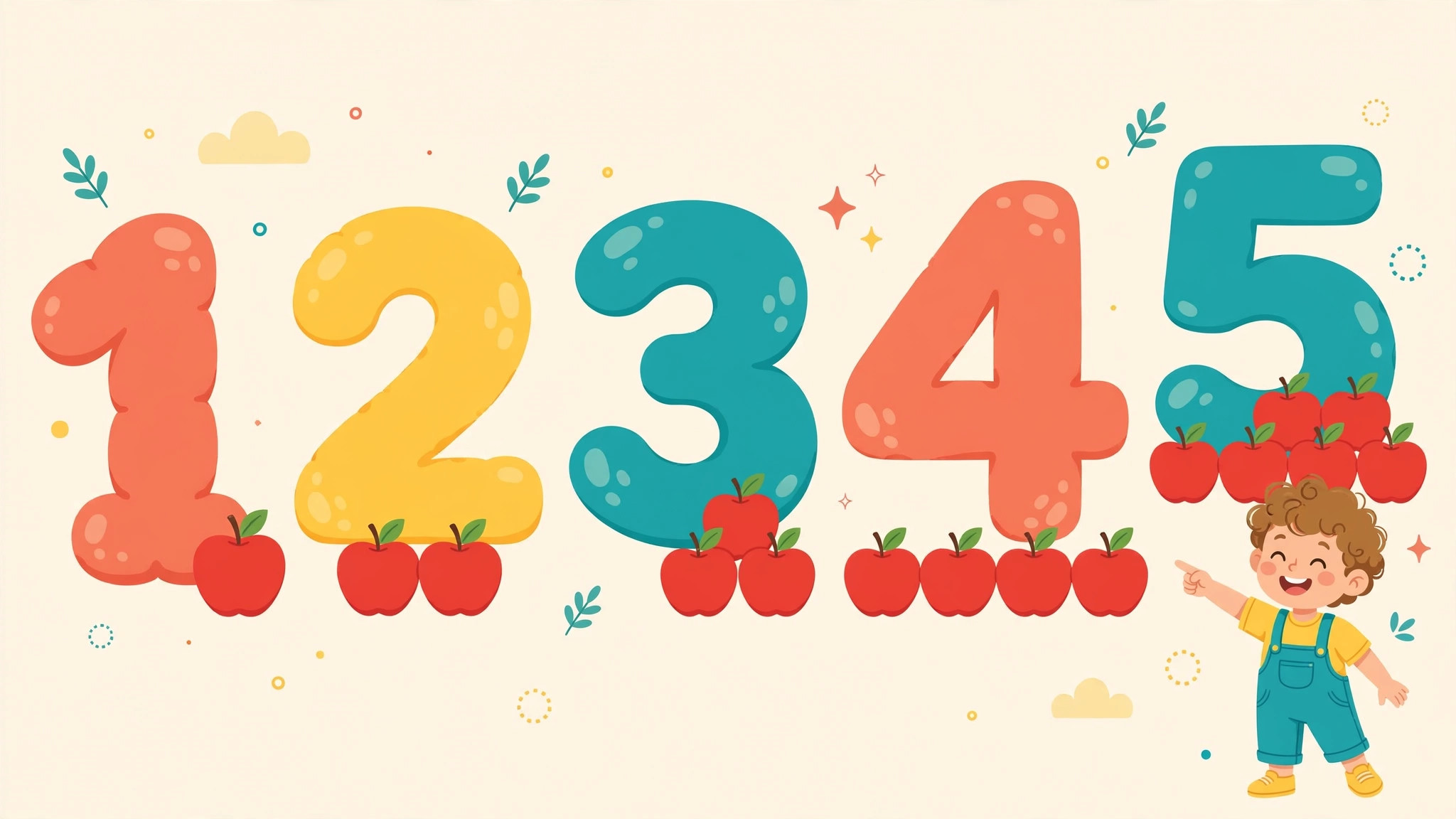
Counting to 20 sounds like one skill, but it is really four skills arriving at different times: chanting the numbers in order, recognizing what each numeral looks like, counting a pile of objects accurately, and understanding that the last number you say tells you how many there are. Once you know that, teaching numbers at home gets much easier, because you can practice each piece separately with tiny, playful activities instead of drilling the whole thing at once.
What "knowing numbers" really means
Most children learn to recite numbers long before they can use them, the same way they sing the alphabet before they can read. Reciting is a great start, but these are the milestones hiding underneath it:
- Rote counting: saying "one, two, three..." in order, from memory.
- One-to-one correspondence: touching or pointing to each object exactly once while counting it.
- Numeral recognition: seeing a written 7 and knowing it says "seven."
- Cardinality: understanding that if you counted 8 blocks, there are 8 blocks, even after you spread them out.
A child can be strong in one and wobbly in another, and that is completely normal. Your job is simply to give all four plenty of low-pressure practice.
Stage 1: Numbers 1 to 5 (start here)
Small numbers come first because young children can often see one, two, or three objects at a glance without counting. Work on 1 to 5 until your child is confident, using this simple progression:
- Count real things together. Count stairs as you climb, spoons as you set the table, and fingers on one hand. Say each number clearly and touch each item as you go.
- Build the "show me" game. Hold up fingers and ask, "How many?" Then flip it: "Show me three fingers."
- Match numeral to quantity. Write the numbers 1 to 5 on sticky notes and stick each one on a small pile of toys with that many pieces.
- Count and stop. Roll a toy car and count its "beeps," then freeze. Games with a stopping point teach control, not just chanting.
Stage 2: Numbers 6 to 10
Once 1 to 5 feel easy, extend the same games to 10. Ten is a magic milestone because our whole number system is built on it, and two hands give you a built-in counting tool your child carries everywhere. Practice pairs that make ten: hold up 7 fingers and ask how many are folded down. Play "count the collection" with a jar of buttons or shells, and start lining objects up in a row before counting, which prevents the double-counting and skipping that happen with scattered piles. Introduce simple number tracing here too: big, chunky numerals your child can trace with a finger first, then a crayon.
Stage 3: The tricky teens, 11 to 20
The teen numbers trip up almost every child, and it is not their fault. Eleven and twelve do not sound like "one-teen" and "two-teen," and thirteen through nineteen say the ones digit first, which is backwards compared to every number that follows. A few tricks help:
- Use the "ten and more" idea. Lay out a full row of ten counters, then add extras beside it. Thirteen becomes "a whole ten, and 3 more." This builds real understanding, not just memory.
- Go slowly through 11 and 12. Give these two oddballs extra repetitions in songs and counting games instead of rushing past them.
- Spot them in the wild. House numbers, elevator buttons, calendar dates, and jersey numbers all reinforce teen numerals painlessly.
- Practice the order both ways. Count up from 9 to 15, start at 14 and count to 20, then try counting backwards from 20 at bath time.
Everyday counting moments (no prep required)
| Moment | What to count | Skill practiced |
|---|---|---|
| Breakfast | Berries, cereal pieces, sips of water | One-to-one correspondence |
| Getting dressed | Buttons, shoes, pockets | Counting to 5 and 10 |
| Car rides | Red cars, buses, traffic lights | Sustained counting to 20 |
| Cleanup time | Toys tossed into the bin, counted aloud | Counting with movement |
| Bedtime | Pages, stuffed animals, goodnight kisses | Teen numbers and counting down |
Common bumps in the road
Nearly every child skips a number in the teens, counts objects faster than they can point, or counts a pile twice and announces a different total each time. These are stages, not problems. Slow the pointing down, line objects up, and count together at your child's pace. If a mistake happens, recount cheerfully instead of correcting sharply; accuracy grows from hundreds of tiny successful counts. And if you're ever concerned about your child's progress, your child's teacher or pediatrician can help you sort out what is typical.
Five games that make counting irresistible
Games give children a reason to count carefully, because the count changes what happens next. Try these favorites:
- Treasure count. Hide ten coins or buttons around one room. Your child hunts, collects them in a cup, then counts the haul to check whether any treasure is still missing.
- Number hopscotch. Chalk or tape the numbers 1 to 10 on the floor. Call a number and your child hops to it, then counts the hops back.
- Store. Put prices of one to twenty pennies on toys and let your child "buy" them by counting out the exact coins.
- Beat the timer. "How many blocks can you stack before I count to twenty?" Counting becomes the clock, and the excitement does the teaching.
- Counting songs with fingers. Songs that count up and down give the teen numbers a tune, and tunes are remarkably sticky in young memories.
Where printables fit in
Worksheets should be the seasoning, not the meal: real objects and games do the heavy lifting. But a good counting printable is perfect for quiet practice: counting pictures and circling the right numeral, tracing big numbers, or connecting dots from 1 to 20. Keep sessions to one page, celebrate the finish, and stop while it is still fun. A child who ends a page smiling will ask for another one tomorrow, and that steady, happy repetition is exactly how numbers 1 to 20 become permanent.
Frequently Asked Questions
What age should my child count to 20?
Many children recite numbers to 20 sometime between ages three and five, and count objects accurately a little later. There is a wide range of typical development, so think in terms of steady progress rather than birthdays. Regular playful practice matters far more than hitting a number by a certain date.
My child always skips 15. How do I fix it?
Slow down and give the teen numbers extra, focused practice. Count together while pointing at a written number line, tap each numeral as you say it, and play games that start at 12 instead of 1. Skipping usually disappears once the sequence gets enough slow, successful repetitions.
Should we learn counting or numeral writing first?
Counting and recognizing numerals come first; writing them develops gradually afterward. Start with reading numbers and counting objects, then move to tracing large numerals with fingers and crayons. Legible writing follows once hand control catches up, so there is no need to push handwriting before counting feels solid.
How much practice does my child need each day?
Five to ten minutes woven into real life is plenty at this age. Count snacks, stairs, and toys during routines you already have, and add one short game or printable a few times a week. Short, cheerful, and frequent beats long, occasional practice sessions every single time.