Dot-to-Dot Puzzles for Kids: The Sneaky Way to Learn Numbers & Pencil Control
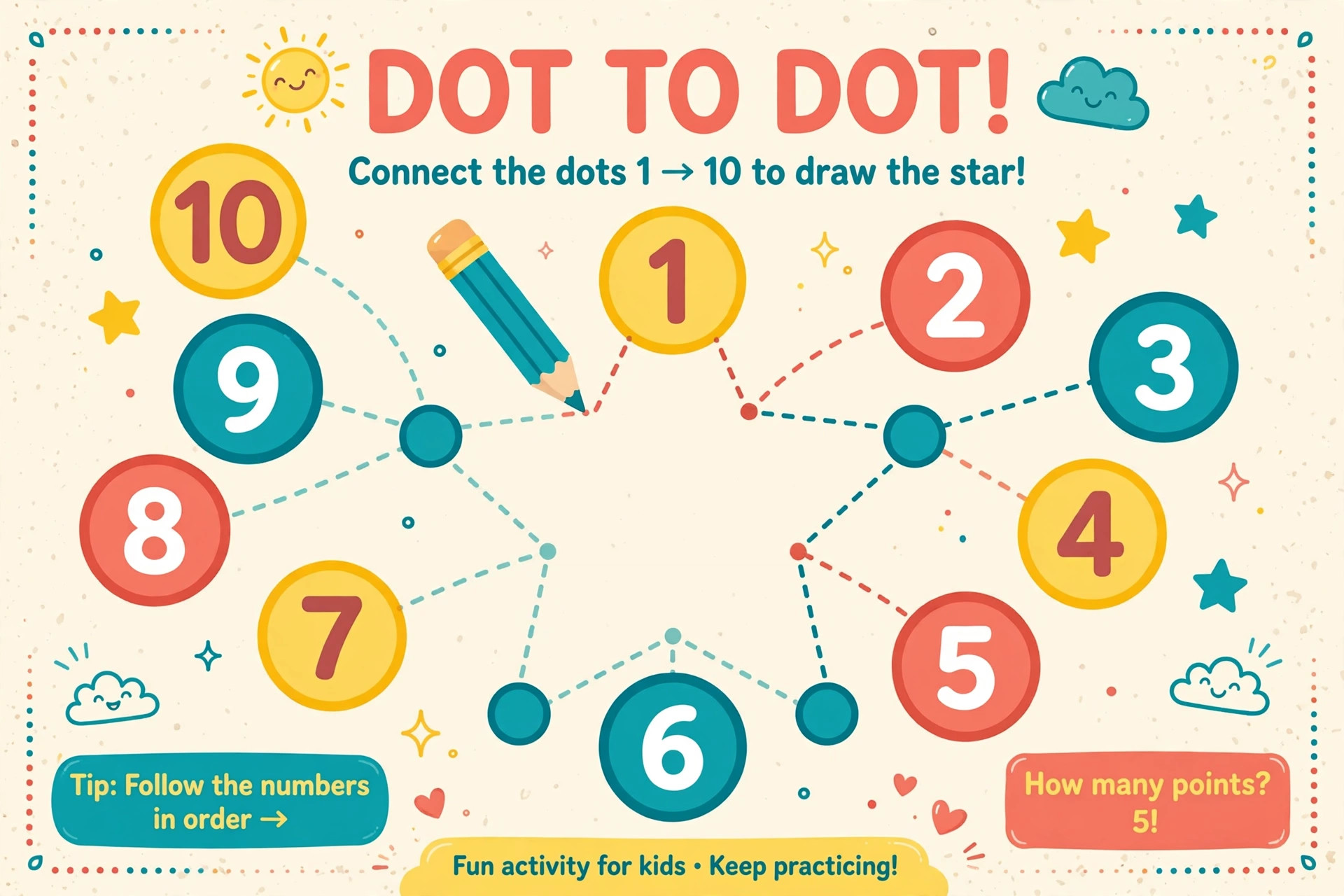
Ask a child to count to twenty and you may get a sigh. Hand them a page of numbered dots hiding a secret picture, and they will count to twenty three times in a row without noticing. That is the quiet genius of dot-to-dot puzzles (also called connect-the-dots): the counting is real, the number order matters, and the pencil control is genuinely demanding — but from the child's side of the table, they are simply hunting for a hidden dinosaur. Here is what these puzzles teach, how to pick the right level, and how to squeeze even more learning out of every page.
What dot-to-dot actually teaches
- Counting in order, with a reason. Worksheets ask children to recite numbers; dot-to-dots make the order functional — skip 7 and the picture breaks. Understanding that numbers live in a fixed sequence is a foundational math idea, and this is often the first place it truly clicks.
- Number recognition under pressure. Finding "14" among thirty scattered dots is real visual searching — the same skill as finding a word on a page or a number in a math problem later.
- Pencil control and planning. Each line must travel to the right dot and stop there. Children learn to look ahead before drawing, slow down near the target, and steer — the exact ingredients of neat handwriting.
- Left-to-right, top-to-bottom scanning. Searching the page systematically for the next number rehearses the eye movements reading will need.
- Prediction and satisfaction. Guessing the hidden picture mid-way, then watching it appear, gives dot-to-dots a story arc most worksheets cannot match.
Choosing the right level
| Level | Numbers used | What it feels like |
|---|---|---|
| First puzzles | 1–10, big dots, widely spaced | A short treasure hunt; success in two minutes |
| Building | 1–20, with a few close-together dots | Real counting with the occasional tricky search |
| Confident | 1–30 or 1–50, denser pictures | A proper project; planning and patience required |
| Twist versions | Counting by 2s, 5s, or 10s; letters A–Z | Skip-counting practice and alphabet order in disguise |
A good level check: your child should be able to count to the top number out loud (with a slip or two forgiven) before starting. If they cannot yet reach the top number comfortably, the puzzle becomes a search for symbols they cannot name, and frustration replaces the fun.
Tips that make every puzzle teach more
- Hover before drawing. Teach the "helicopter" move: hold the pencil tip just above the page, find the next dot, then land and draw. It prevents the scribbled corrections that happen when the pencil searches while moving.
- Chant quietly together. A soft running count — "…eleven, twelve, thirteen…" — keeps the sequence in the ear while the eyes search. It feels like a team sport and keeps momentum when a dot hides.
- Predict at halfway. Pause at the midpoint and guess the picture. Prediction turns a counting exercise into a mystery, and children will finish just to grade their own guess.
- Finish the picture. Once the outline appears, coloring it in doubles the fine-motor practice and gives the page a proud fridge-worthy ending.
- Go backward sometimes. For confident counters, try connecting from the biggest number back down to 1. Counting backward is a genuinely useful — and hilariously wobbly — challenge.
Make your own dot-to-dot
Homemade versions take minutes and let you target exactly the numbers your child is learning. Draw a very simple shape — their initial letter, a star, a house, a fish — as a series of dots along the outline, then number them in order. Start with 10–15 dots. For a second round, trace a favorite coloring page lightly and place dots on its outline. Children can also make puzzles for you; setting the numbers in the right order is itself excellent practice, and watching a parent hunt for dot 17 is, reportedly, priceless. Dot-to-dots also travel beautifully — two folded puzzles and a pencil can turn a waiting room, a car ride, or a restaurant table into a calm counting game.
Fresh challenges for confident counters
Once plain 1-to-30 puzzles feel easy, twists keep the format alive for another year or two. Skip-counting puzzles — connect 2, 4, 6, 8 or 5, 10, 15, 20 — rehearse the exact sequences that times tables will soon demand. Two-color hunts split one picture across two number runs (odds in one color, evens in another), adding a classification step to every search. Timed replays of a favorite page, raced against the child's own earlier time rather than anyone else's, satisfy kids who love a scoreboard. And a blank-dot challenge — a puzzle with a few numbers deliberately missing, which the child must work out and write in before connecting — flips them from follower to co-author. The format flexes a long way before it runs out of road; most children leave it behind because pictures change, not because the counting stops being useful.
Common mistakes to avoid
- Starting too high. A 1–50 puzzle for a child still shaky at 15 teaches only that dot-to-dots are "too hard." Levels climb quickly once confidence does.
- Rescuing too fast. When a dot hides, wait. Offer a scanning strategy ("check near the last dot; numbers like to hide close") instead of pointing — the search is the exercise.
- Skipping the counting sound. Silent dot-to-dot still trains control, but saying the numbers aloud is where the counting fluency comes from. Keep the chant.
- Counting the page as finished at the last dot. Naming the picture, coloring it, and admiring the result seals the experience — children repeat activities that end in pride.
Dot-to-dots have survived a century of classrooms for one reason: they respect how children actually learn. The numbers are needed, the picture is wanted, and the pencil behaves because the mission demands it. Keep the levels climbing gently, chant along, and let the hidden pictures keep smuggling counting practice into playtime.
Frequently Asked Questions
What age is right for dot-to-dot puzzles?
Children who can count reliably to ten and recognize most written numbers to ten — often around ages four to five — are ready for 1–10 puzzles. Younger children can enjoy a grown-up-guided version with very few dots. The counting range matters more than the birthday: match the puzzle's top number to what they can already say.
My child counts well but keeps missing dots. How can I help?
Teach a search pattern: start each hunt near the last dot, then sweep the page left to right like reading. The helicopter technique — hovering the pencil while searching, landing only when the dot is found — prevents most stray lines. Busy pictures also get easier when you cover the far side of the page with a blank sheet.
Are letter dot-to-dots (A to Z) as useful as number ones?
They teach the same control and scanning skills, plus alphabet order — a genuinely handy sequence for later dictionary and filing skills. They work best once a child recognizes most capital letters. Many kids enjoy alternating: a number puzzle one day, a letter puzzle the next, both ending in the same satisfying reveal.
Can dot-to-dots help with handwriting?
Yes, in a supporting role. The puzzles train steering to a target, stopping on purpose, and planning the next move — all shared with letter formation. They will not replace letter practice, but as a warm-up before tracing worksheets they wake up exactly the control handwriting needs, which is why teachers often pair them together.