Counting Games with Household Objects (No Prep Needed)
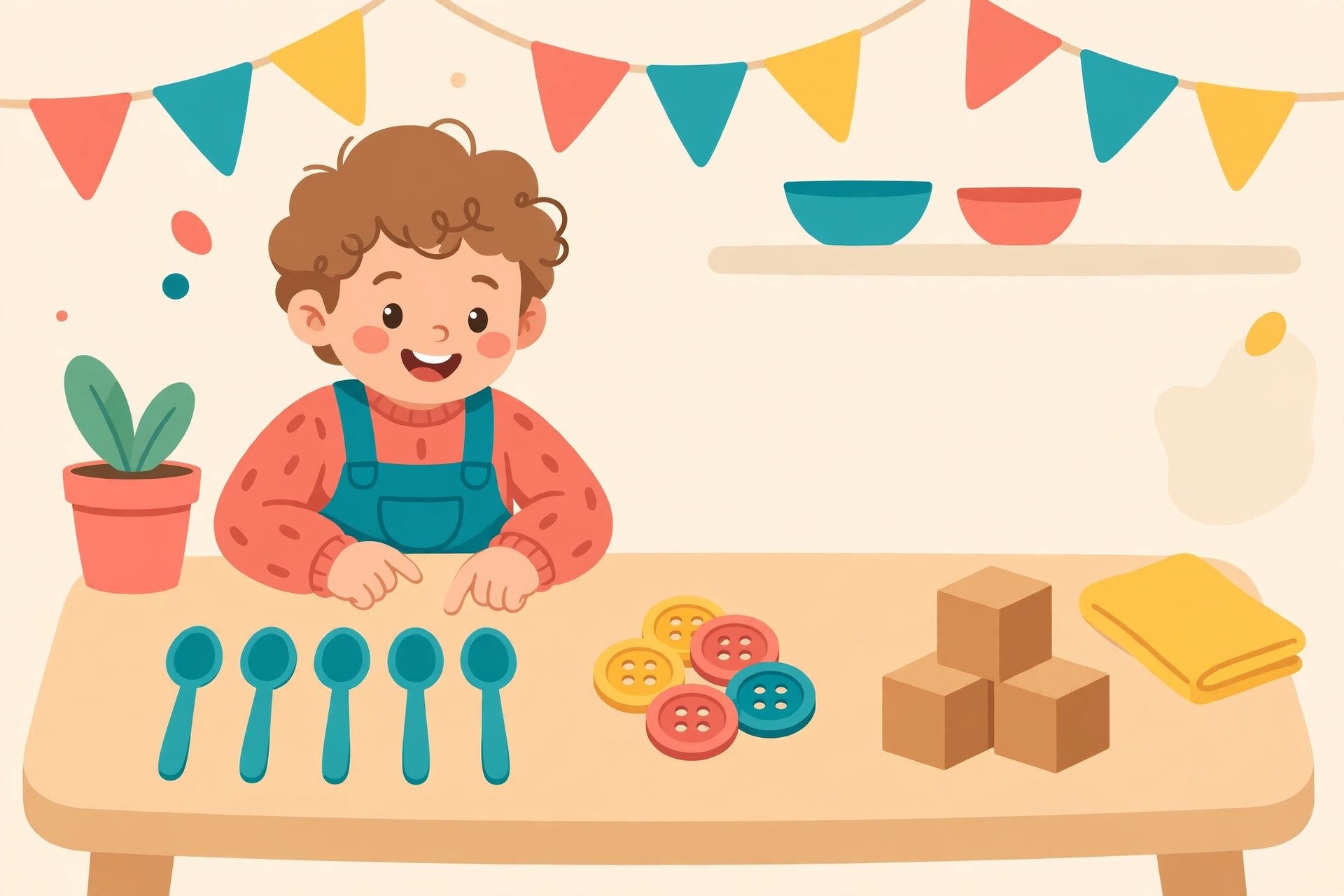
Some of the best math lessons in your house are hiding in the laundry basket. Young children learn numbers by touching, moving, and grouping real things — and the objects they need are already in your kitchen drawers and toy bins. You do not need a workbook, an app, or a shopping trip. You need ten minutes, a handful of everyday items, and a game.
Counting games build more than reciting "one, two, three." They teach one-to-one correspondence (touching one object for each number word), cardinality (understanding that the last number said is the total), and early comparing — more, fewer, equal. Below are seven games that take zero prep and can be repeated all week without getting stale.
What to gather (2 minutes)
Walk through two rooms and collect a basket of countable things: socks, spoons, bottle caps, crayons, blocks, coins, dried beans, or grapes. Aim for sets of 10 to 20 of the same item, because "how many?" is easiest to answer when everything matches. Add a muffin tin, an ice-cube tray, or a few small bowls for sorting. That is the entire supply list.
Game 1: Sort and count
Dump the sock pile on the floor and ask your child to sort it — by color, by size, or by whose socks they are. Then count each group out loud, touching every sock once. Ask the golden question: "Which group has more? How do you know?" Sorting first gives counting a purpose, and comparing groups is the beginning of real number sense.
Game 2: Snack math
At snack time, put 12 grapes or crackers on a plate and let your child count them as they eat. It sounds simple, but eating the objects forces careful tracking — nothing gets counted twice, because it is gone. Level it up with requests: "Give me 5. Now give me 3 more. How many did I get altogether?" That is addition, served with a snack.
Game 3: The counting store
Set five or six toys on a "shelf" (the couch works) and price them with sticky notes: 1 coin, 3 coins, 5 coins. Give your child a cup of pennies or buttons as money. They shop, count out the right number of coins, and hand them over. This game quietly teaches counting with value, patience, and turn-taking — and kids will play it long after a worksheet would have been abandoned.
Game 4: Stairs and steps
Count the stairs every time you climb them. Count steps from the door to the mailbox. Count jumps, claps, and hops in place. Movement counting is perfect for wiggly kids who resist sitting still, and counting backwards on the way down ("5, 4, 3, 2, 1 — blast off!") plants the seed for subtraction later.
Game 5: Guess my number of beans
Put a small handful of beans in a jar. Everyone guesses how many, then you count together to check. Estimation is an underrated skill: it teaches kids what numbers feel like, so that later, when a math answer is wildly off, they notice. Start with 8 to 15 beans for preschoolers and go higher as they grow.
Games by age: a quick guide
| Age | Count up to | Best games |
|---|---|---|
| 2–3 years | 5, then 10 | Sort and count, stairs and steps |
| 4–5 years | 20 | Snack math, counting store, bean jar |
| 6–7 years | 100 (by 2s, 5s, 10s) | Store with prices to 25 coins, bean jar, counting collections |
These are friendly ranges, not deadlines. Children develop at very different speeds, and a child happily counting to 8 at age four is learning beautifully. If you are ever concerned about your child's progress, your child's teacher or pediatrician can help you understand what to expect.
Three rules that keep games fun
- Stop while it is still fun. Five cheerful minutes beat fifteen forced ones. End the game before your child wants to.
- Let mistakes pass. If they skip 13, just count along correctly next time. Modeling beats correcting.
- Count real things daily. Plates for dinner, pages in the bedtime book, cars that pass. Repetition in real life is what makes numbers stick.
Game 6: The counting collection
Once a week, hand your child a basket and a mission: collect exactly 20 of something — pebbles, leaves, red toys, things that are round. Counting a mixed collection is harder than counting identical objects, because your child must keep track of what has been counted. Teach the pro move: slide each counted item into a "done" pile as you say its number. When the collection is complete, line the items up in rows of five or ten and count again. Rows make the total visible at a glance, and they are a first taste of the grouping that multiplication is built on later.
Adding pencil and paper (when they are ready)
After a counting game, offer — never require — the chance to record it. A preschooler might draw the five socks they counted and make five tally marks beside them. A six-year-old can write the number, then draw a quick picture of the set. This tiny bridge from objects to symbols is exactly how written math is born: first the real thing, then a picture of the thing, then the numeral that stands for it. Keep a few of these recordings in a folder. Over a few months, the folder shows progress more honestly than any test: bigger numbers, neater tallies, and a child who reaches for paper on their own.
Turning games into a tiny routine
Pick one game for the week and attach it to something you already do — socks on laundry day, snack math on Tuesdays, stairs every day. A two-minute game repeated ten times teaches more than a single long session. When a game gets too easy, change one thing: count bigger sets, count by twos with pairs of socks, or write the number down after counting. Small steps, real objects, zero prep — that is early math at its best.
Frequently Asked Questions
How long should a counting game last?
Five to ten minutes is plenty for children under seven. Young attention spans are short, and the goal is a happy repetition, not a long lesson. Several tiny games spread through the day — counting stairs, spoons, and socks — will teach more than one long sit-down session.
My child counts but skips numbers. Should I worry?
Skipping a number, especially in the teens, is completely typical for preschoolers and early counters. Keep counting together out loud and let them hear the correct order often. If you are ever concerned about your child's overall progress, their teacher or pediatrician can help.
What if my child refuses to play counting games?
Then shrink the game and raise the fun. Count things they already love — dinosaurs, hair clips, blueberries — and join in yourself rather than quizzing. Many children who resist 'math time' will happily count when it is part of snack, bath, or a silly race.
Do I need special counting toys or manipulatives?
No. Purpose-made counting bears are nice, but socks, spoons, beans, and coins do the same job for free. Real household objects have a bonus advantage: children see that numbers describe the world they actually live in, not just a special set of school supplies.