Color by Number for Kids: How It Teaches More Than Colors
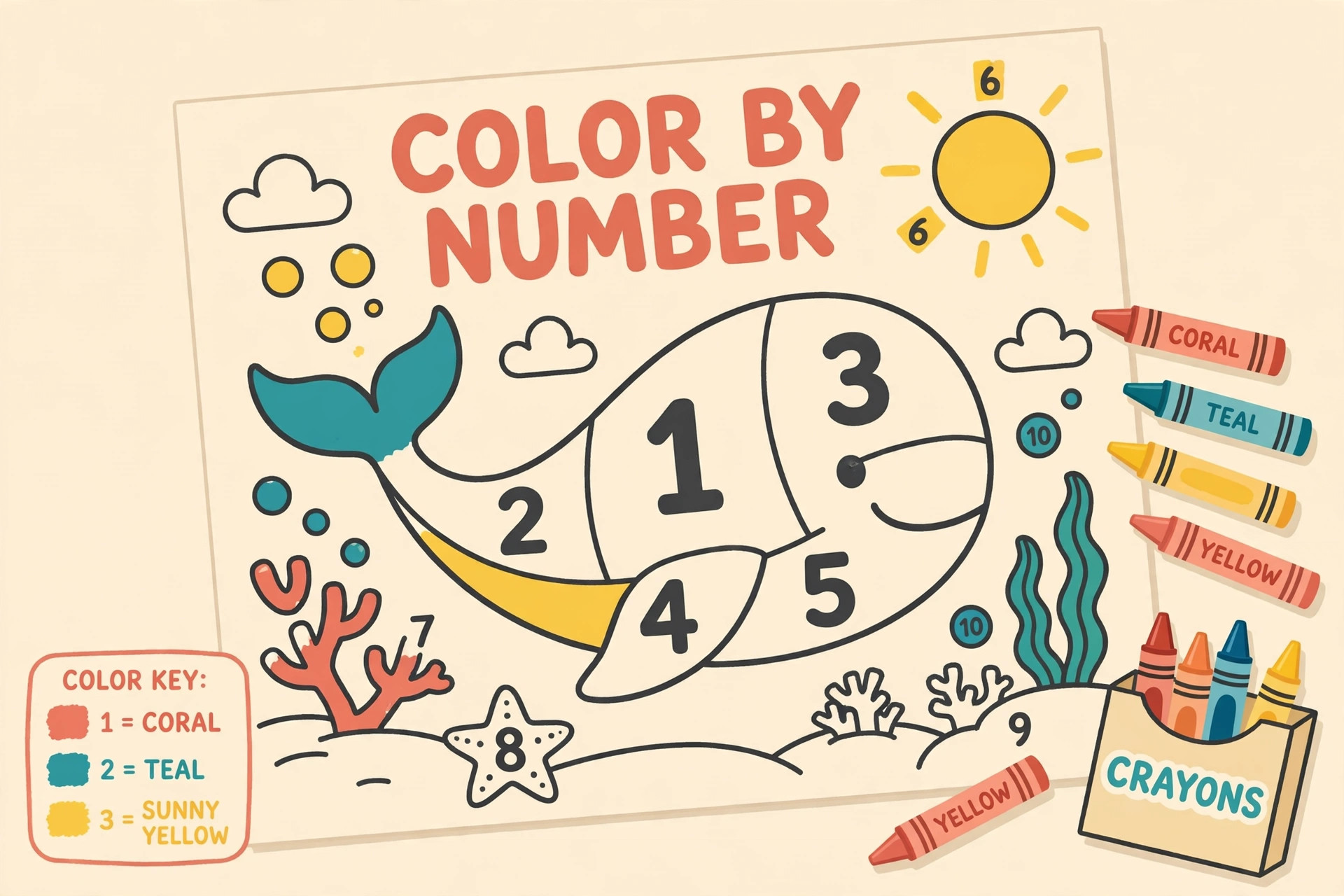
Color by number looks like the simplest activity in the world: find the 3s, color them blue; find the 5s, color them green. Yet tucked inside that little numbered picture is a surprising amount of learning — number recognition, symbol matching, planning, patience, and the deep satisfaction of a picture appearing exactly as promised. It is one of the few activities that children experience as pure play while it quietly rehearses half the skills of a math lesson. Here is what is actually being learned, how to choose the right level, and how to make your own.
What color by number really teaches
- Number and symbol recognition. Every region asks the same question: can you find and name this symbol? That repeated hunt builds fast, automatic recognition — the same automaticity that later makes written math feel easy.
- Reading a key. A color-by-number key is a child's first legend: symbols stand for something else, and you must check the chart before acting. Maps, graphs, and diagrams all work this way, so this is genuine early data literacy wearing a party hat.
- Planning and scanning. Smart colorers learn to finish all the 3s before swapping pencils, scan the whole picture before starting, and save the tiny regions for when their hand is warmed up. That is executive function, practiced voluntarily.
- Fine motor control with a purpose. Small regions demand careful edges; big regions reward long smooth strokes. Because the finished picture "matters," children willingly work harder on control than they ever would on a plain practice sheet.
- Focus and follow-through. A half-finished color-by-number is visibly unfinished, which gently pulls children back to complete it — stamina training disguised as a rainbow.
Choosing the right level
| Level | What it uses | Best first sign your child is ready |
|---|---|---|
| Starter | Colors only — each area shows a colored dot or crayon picture instead of a number | Can match identical colors and hold a chunky crayon |
| Numbers 1–5 | Big regions, five colors, no tricky neighbors | Recognizes most numbers to 5, even if slowly |
| Numbers 1–10 | More regions, smaller details, colors with similar neighbors | Counts and recognizes numbers to 10 with confidence |
| Advanced | Letters, number words, or simple sums (2 + 3) as the code | Reads some letters/words or adds small numbers with fingers |
The test of a good match: your child should finish with effort but without rescue. If you are naming every number for them, drop a level — success at an easier level teaches more than struggle at a harder one.
How to get the most from one page
- Color the key first. Have your child color each box in the key with the correct crayon. The key becomes a reference they made themselves, and half of all "which color is 4?" questions disappear.
- Hunt before coloring. Ask them to point to every region with the same number first — pure recognition practice, and it feels like a treasure hunt.
- One number at a time. Finish all regions of one number before picking up the next color. Swapping colors constantly breaks concentration and loses the thread.
- Let them spot your "mistake." Deliberately start coloring a 6 with the color for 9 and let them catch you. Teaching the rule back to you locks it in — and is apparently hilarious.
Make your own color-by-number
DIY versions take five minutes and carry a special magic because the picture is one your child already loves. Print or draw any simple coloring page with clear, closed regions. Decide a short key — four to six colors is plenty. Write a small number inside every region, then copy the same numbers into a key box with the matching color names or colored dots. For a harder twist, replace the key's numbers with simple sums or number words. Children also adore making one for a parent or sibling to solve, which flips them from student to teacher.
One page, three rounds of learning
A single color-by-number page can stretch much further than one coloring session. In round one, your child simply completes it as designed. In round two — on a fresh copy a few days later — cover the key after they have studied it and see how much they remember: memory and confidence both get a workout, and any peeking is self-directed revision. In round three, hand over the role of inventor: your child chooses new colors for the key, re-codes a fresh copy, and gives it to a sibling, friend, or parent to solve. Designing a key teaches the symbol system from the other side — arguably the deepest learning of the three rounds. This is also why it is worth printing two copies of any page your child especially loves: today's masterpiece becomes next week's teaching material, and the progression from solver to puzzle-maker is a milestone worth noticing.
Common mistakes to avoid
- Choosing pages that are too dense. Tiny slivers and twelve-color keys end in tears and a half-colored page abandoned forever. Big and simple wins.
- Enforcing the "correct" colors. If your child wants the sky purple and the grass orange, the learning goals — recognition, key-following, control — are still fully met. Save color realism for another day.
- Rushing the reveal. Guessing what the picture will become is half the fun. Resist narrating it in advance.
- Treating it as a test. The moment it feels graded, it stops being the activity children ask for by name. Help freely; score never.
Color by number earns its place in the printable stack because it sits exactly where good learning lives: a clear goal, a fair challenge, and a small triumph waiting at the end. Keep a few levels on hand, let your child pick the picture, and watch a quiet page of numbers do far more teaching than it ever admits to.
Frequently Asked Questions
At what age can kids start color by number?
Many children are ready for color-matching versions — where each area shows a colored dot instead of a numeral — around age three. Number-based versions usually click between ages four and five, once a child recognizes a few written numbers. Start with numbers 1 to 5 and big regions, and let recognition grow naturally.
My child colors the regions but ignores the numbers. Is it still useful?
Yes, though you can nudge the learning along. Try coloring the key boxes together first, then play the hunting game: 'Can you find all the 4s before we color them?' If naming every number makes it feel like work, the page may simply be one level too hard right now — drop down and rebuild momentum.
Is color by number too rigid? Shouldn't coloring be free and creative?
Both kinds of coloring matter, and they do different jobs. Free coloring builds imagination and expression; color by number builds recognition, planning, and follow-through. Think of them as different tools rather than rivals — most children happily alternate, choosing the puzzle-like satisfaction of a coded page on some days and total freedom on others.
Can color by number help a child who dislikes math?
It is one of the gentlest bridges available, because the numbers arrive as a treasure hunt rather than a lesson. Children practice recognizing and hunting numerals inside an activity whose goal is a picture, not a correct answer. Keep the sums-free versions for reluctant learners first, and let repeated small successes change how numbers feel.