Benefits of Mazes for Kids: Problem-Solving, Focus & Pencil Skills
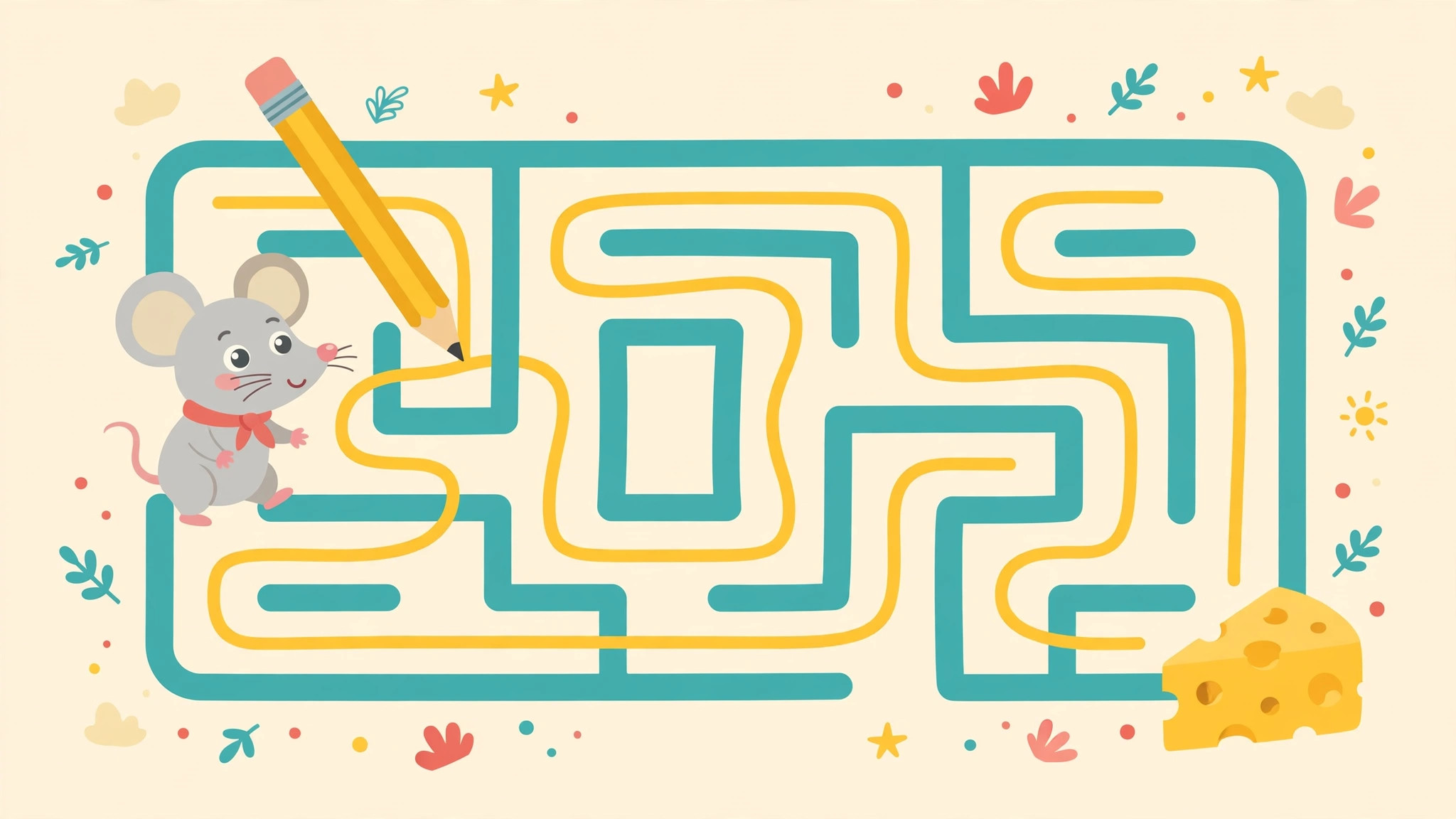
A maze looks like simple fun — a character needs to reach the treasure, the bunny needs to find the carrot. But while your child traces the path, their brain is doing serious work: scanning ahead, making decisions, remembering dead ends, and controlling a pencil with precision. Few worksheets pack so much learning into something children actually ask to do again.
What mazes really teach
- Planning ahead: A maze can't be solved one corner at a time. Children learn to look ahead before moving — the same skill used in maths problems, reading, and eventually, essays.
- Visual tracking: Following a path with the eyes, without losing the line, is closely related to following lines of text when reading.
- Fine motor control: Staying inside the path — turning corners without crossing walls — builds the precise pencil control needed for neat letter formation.
- Working memory: "I already tried that way" is memory in action. Children hold a mental map of tried routes while testing new ones.
- Patience and persistence: A dead end isn't failure; it's information. Mazes give children a safe, low-stakes place to practise backing up and trying again.
The right maze for each age
| Age | Best maze style | What success looks like |
|---|---|---|
| 3–4 | Very wide paths, one or two turns, picture start and finish | Traces with a finger first, then a chunky crayon |
| 4–5 | Wide paths with a few clear choices | Mostly stays in the path; enjoys simple dead ends |
| 5–6 | Medium paths, several dead ends | Starts looking ahead before moving |
| 7+ | Narrower paths, complex branching, timed challenges | Plans a full route and self-corrects calmly |
Start easier than you think. A maze that's slightly too easy builds confidence and speed; one that's too hard just teaches frustration. If your child is crossing walls constantly, the paths are too narrow — step back a level.
How to work a maze together (step by step)
- Look first. Before touching the pencil, have your child point at the start and the finish. "Where do we need to end up?"
- Trace with a finger. Young children should always do a finger run first — it lets them plan without the pressure of leaving a permanent line.
- Talk at the choices. At each junction, pause: "Left or right? What do you see down that way?" This narration is where the planning skill grows.
- Mark dead ends lightly. A small X or dot on a failed route teaches systematic thinking — real problem-solvers keep track of what they've tried.
- Celebrate the route, not the speed. "You didn't give up at that tricky corner" builds far more persistence than a stopwatch.
Five ways to get more out of every maze
- Reverse it: solve the same maze from finish to start — a surprisingly different challenge.
- Copy the route: after solving, have your child draw the solution path again from memory on a blank copy.
- Make your own: drawing a maze for someone else is advanced planning practice. Start with squared paper and a simple path.
- Go giant: chalk a maze on the driveway, build one from cushions, or tape lines on the floor and walk it.
- Time it (later): once a child is confident, racing their own best time adds excitement without competing against others.
Paper mazes vs maze apps
Apps can be fun, but paper mazes give two things screens can't: real pencil control practice, and visible thinking. On paper, you can see where your child hesitated, planned, or guessed — and that tells you exactly what they're learning. If you print mazes, slip a favourite into a clear plastic sleeve and use a dry-erase marker, so it can be solved again and again.
Maze fun beyond the worksheet
Once your child enjoys basic mazes, stretch the skill in new directions:
- Story mazes: tell a tale as they solve — the knight is sneaking past the sleeping dragon, so he must move slowly and quietly. Narrative slows children down and makes them care about each turn.
- Two-person mazes: solve side by side on identical copies, not as a race but comparing routes at the end: "We chose different ways and both worked!"
- Counting challenges: how many turns does the shortest route need? How many dead ends did you visit? Quiet maths hides inside the fun.
- Travelling mazes: a small stack of printed mazes is perfect for waiting rooms, restaurants, and journeys — screen-free, silent, and genuinely absorbing.
- Mazes with a job: deliver the letter to the postbox, help the bee find the flower, guide the ambulance to the hospital. A mission motivates children who find abstract paths boring.
You can also connect mazes to real navigation: draw a simple map of your home or street together and talk about routes and landmarks. Children begin to see that maps, mazes, and directions are all the same kind of thinking — knowing where you are, where you're going, and how to get there. That spatial confidence supports everything from following classroom instructions to, years later, learning to drive. Keep a small folder of finished favourites, too — revisiting an old maze and finding it easy is powerful proof for a child that practice genuinely works.
Common mistakes to avoid
Don't solve it for them — the struggle at the junction is the learning. Don't start with the hardest maze in the book to "challenge" them. And avoid treating every crossed line as an error to fix; wobbly lines are normal while control is developing. Choose encouragement about strategy: "I noticed you checked both ways before choosing — that's what good maze-solvers do."
Mazes won't replace reading, maths, or play — but as a five-minute brain workout that children genuinely enjoy, they're hard to beat. And if you're ever concerned about your child's development in any area, your child's teacher or pediatrician can help you see the bigger picture.
Frequently Asked Questions
What age should kids start doing mazes?
Most children can enjoy very simple mazes around age three or four — wide paths, just one or two turns, and a fun picture goal. Start by tracing the route with a finger before using a crayon. If paths are being crossed constantly, the maze is simply too hard; step back a level.
How do mazes help with school skills?
Mazes build several school-ready skills at once: visual tracking used in reading, the pencil control needed for writing, working memory, and planning ahead. They also practise persistence in a low-stakes way — hitting a dead end and calmly backing up is exactly the mindset children need for tricky maths and spelling.
My child rushes and scribbles through mazes. How can I slow them down?
Make finger-tracing non-negotiable before the pencil comes out, and add a storytelling rule: the character can only move while your child narrates what it sees. Choosing mazes with slightly narrower paths also forces care. Praising careful strategy — not fast finishes — quickly changes the habit.
Are maze apps just as good as paper mazes?
Apps practise the planning and problem-solving parts, but they skip the pencil-control practice that makes paper mazes so valuable for early writing. On paper you can also see your child's thinking — hesitations, guesses, self-corrections. A mix is fine, but paper should be the main course for young children.